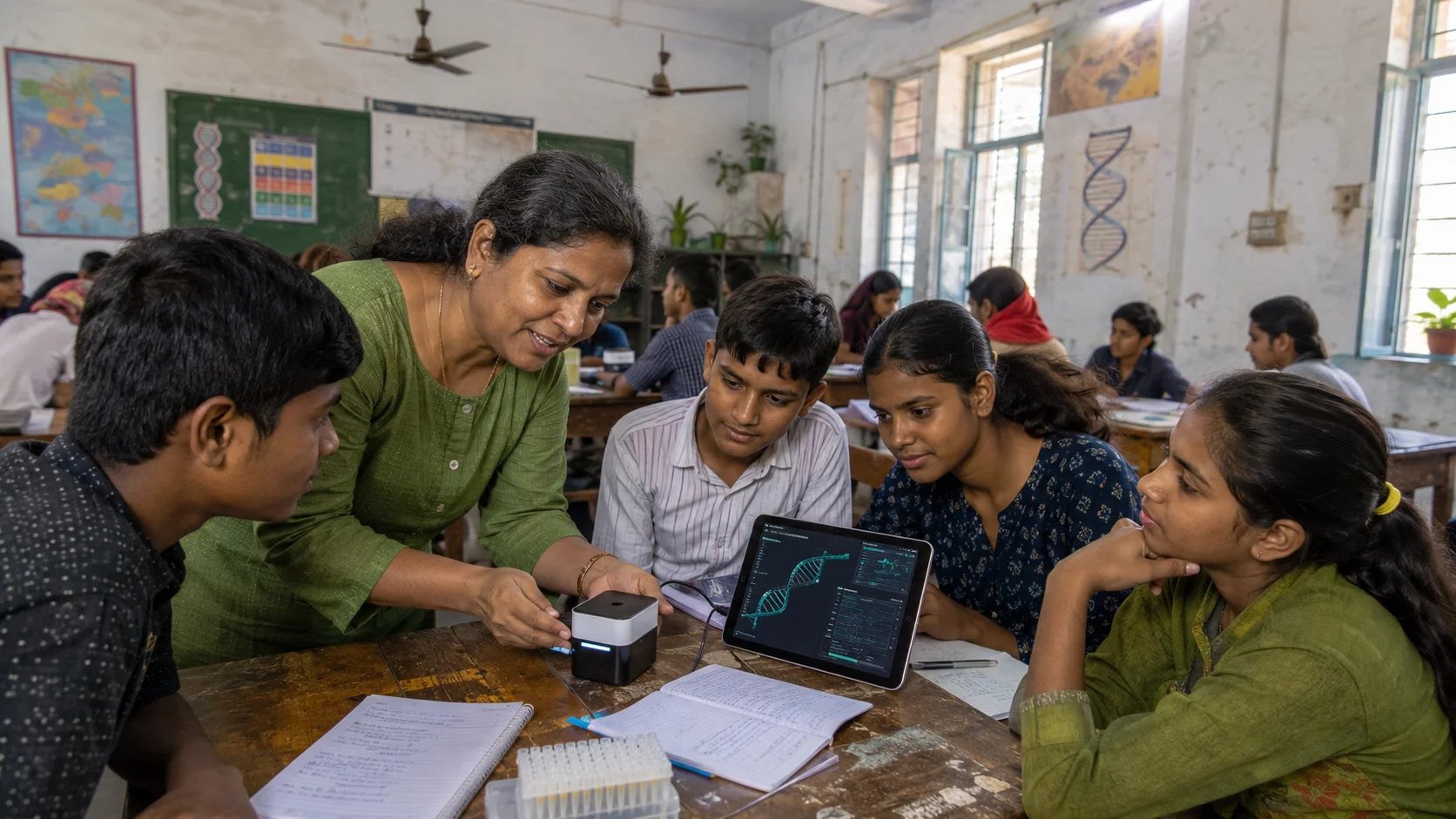
Teaching genomics should not mean starting from scratch.
Genomics is no longer just a specialist biology topic. It is becoming part of medicine, family life, food, biodiversity, privacy, policing, sport, ancestry, reproduction, climate adaptation, AI and the future economy.
Because students are already inheriting a world where DNA is medical information, family information, industrial material and political power.
The Genomic Power Shift is written to make this world understandable. It gives educators accessible, engaging material that can be adapted into lessons, seminars, reading groups, workshops, debates and student projects across many levels and backgrounds.
Teachers already do extraordinary work translating the future for their students, often with limited time and resources that cannot always keep pace. This book is designed to help: clear enough for non-specialists, serious enough for discussion, and broad enough to connect biology with society.
Get in touch about teaching materials
Why this belongs in classrooms now
Students do not need to become geneticists to understand genomics. But they do need to understand how DNA data, genetic testing, gene editing, precision medicine, biobanks, ancestry databases, biodiversity genomics and synthetic biology are changing the world around them.
These questions now sit across biology, sociology, ethics, law, medicine, environmental science, computer science, citizenship and economics. Many existing textbooks may cover parts of the science, but few bring the biological and social sides together in a way that feels current, accessible and empowering.
The aim is to help students ask better questions without frightening them or drowning them in terminology: What can genomics do? Who benefits? Who decides? What could go wrong? What should we protect? What kind of future do we want to build?
What educators can take from the book
Plain-English explanations
Accessible explanations of DNA, genomes, sequencing, gene editing, genetic testing, precision medicine, ancestry, biodiversity and synthetic biology.
Discussion questions
Chapters that can become classroom debates about privacy, fairness, family, identity, medicine, conservation, reproduction, AI and the future of biotechnology.
Case studies
Real-world examples that connect biology with clinics, companies, ecosystems, law, policy, families and public trust.
Cross-disciplinary lessons
Material that connects biology with sociology, ethics, data science, history, citizenship, philosophy, environmental studies and business.
Interactive activities
Starting points for role-play, scenario planning, decision-making exercises, student presentations, future-mapping activities and group discussions.
Student empowerment
Ways to help students feel informed rather than overwhelmed, curious rather than excluded, and ready to participate in decisions about the genomic future.
Suitable for many levels and backgrounds
The book is written for intelligent non-specialists. That means it can support mixed-ability groups, interdisciplinary classes, general education, science communication, sixth-form or high-school enrichment, undergraduate seminars, public health teaching, ethics modules, outreach programmes and adult learning.
Different groups can use the same material at different depths. Younger students might begin with identity, inheritance, disease, conservation or fairness. Older students can go deeper into gene editing, genomic data, regulation, biosecurity, precision medicine, AI biology, reproductive choices, biodiversity and the politics of biological information.
Introductory
For general readers, younger students, public engagement and science clubs. Possible activities include glossary work, short readings, myth-busting, DNA in daily life and “what would you do?” discussions.
Intermediate
For high-school, sixth-form, undergraduate introductory courses and interdisciplinary seminars. Possible activities include debates, case studies, policy exercises, ethics discussions, patient stories and biodiversity examples.
Advanced
For university courses, professional education, medical humanities, bioethics, biotech, public policy and science communication. Possible activities include scenario planning, regulatory analysis, stakeholder mapping, risk analysis, futures workshops and student-led seminars.
Possible lesson and session themes
- What is a genome?
- What can DNA tell us — and what can it not tell us?
- Genetic testing in families
- Rare disease and diagnosis
- Cancer genomics and precision medicine
- CRISPR and gene editing
- Designer babies, embryo testing and reproductive choice
- DNA ancestry and identity
- Genomic data privacy
- Biobanks, consent and research
- Forensic genealogy and policing
- Genetics, race and population history
- Genomics in sport and talent prediction
- Biodiversity, environmental DNA and conservation
- Gene drives and ecosystems
- Synthetic biology and biomanufacturing
- AI and the future of biology
- Biosecurity and dual-use science
- Who owns genetic information?
- What should students know before taking a DNA test?
Interested in developing teaching materials around the book?
I would be very happy to hear from educators, schools, universities, curriculum teams, museums, public-engagement groups, science centres, charities, professional bodies and education publishers interested in turning The Genomic Power Shift into practical teaching materials.
That could include lesson plans, reading guides, discussion prompts, classroom activities, student worksheets, teacher notes, seminar outlines, workshop formats, public education events, online courses or interdisciplinary modules.
The book is already designed to generate this kind of material. Many chapters naturally lend themselves to questions, role-play, debates, case studies and scenario-based learning.
A bridge between biology and society
Many students encounter genomics as a technical topic: DNA, genes, inheritance, sequencing, mutations. But genomics also raises human questions: family, privacy, identity, inequality, medicine, disability, ecosystems, food, justice, surveillance, reproduction and the future of life.
The Genomic Power Shift is designed to sit between those worlds. It gives students enough science to understand what is happening, and enough social context to understand why it matters.
Support for non-specialists
The site also includes a plain-English glossary of common genomic terms, so students can build confidence without needing to memorise jargon before they begin.
The goal is to give students enough language to join the conversation, whether or not they ever become molecular biologists.
Want to bring genomics into your teaching?
If you are teaching, designing a course, planning a workshop, building a public-engagement programme or trying to help students understand the genomic future, I would be glad to hear from you.
Join the launch list for occasional notes, sample material, publication updates and future education-focused resources — and share the book with students, colleagues, friends, school leaders, education teams or funders who need an accessible way into genomics and its implications.