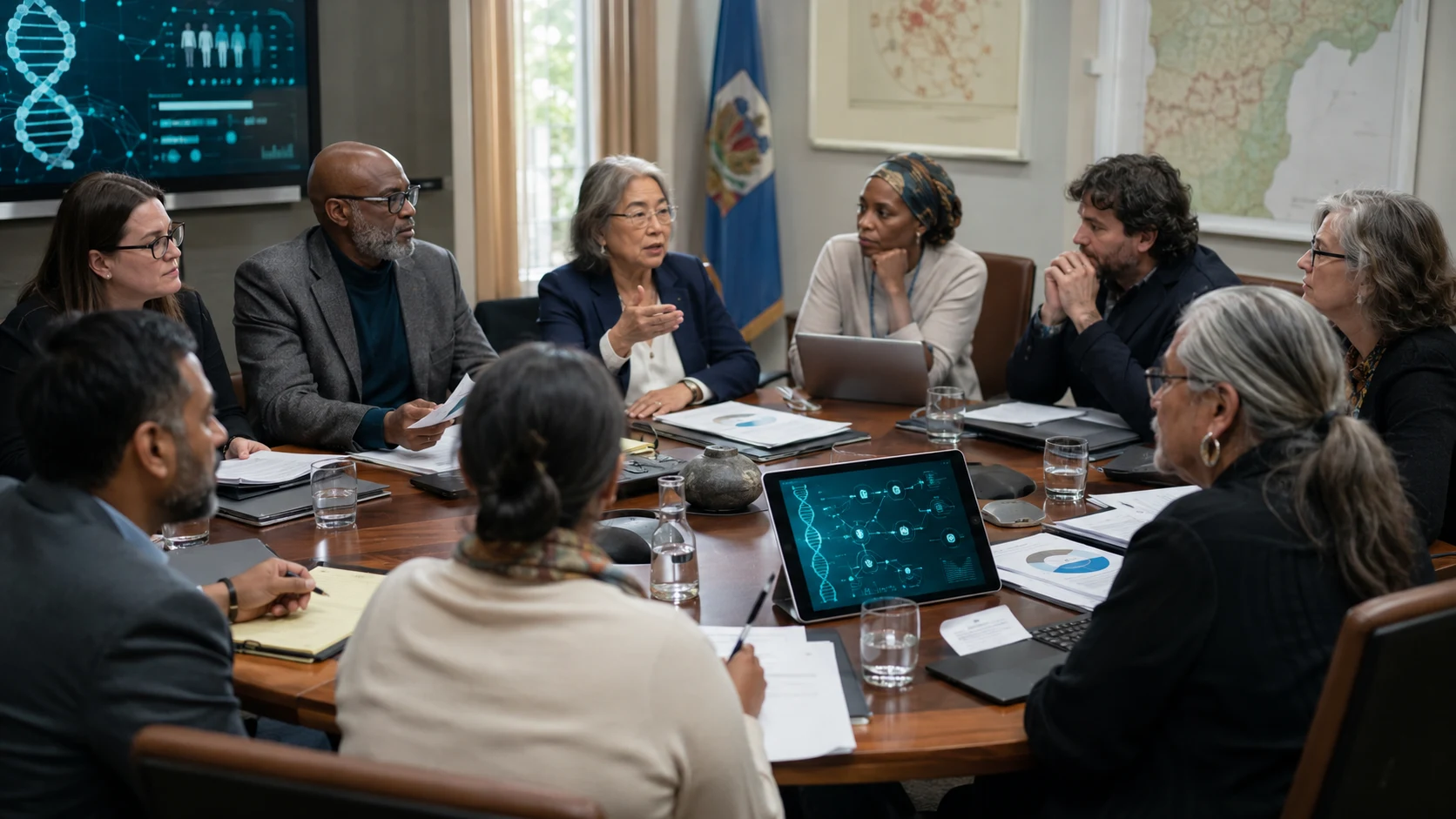
How do we govern genomics without wasting its promise?
Genomics is moving fast. Legislators, civil servants, regulators and public institutions are being asked to enable innovation, protect the public, support healthcare, safeguard ecosystems, understand new markets and keep up with technologies that do not fit neatly into old categories.
The challenge is not simply whether genomics is good or bad. It is where it is being used, who is affected, who benefits, who pays, what scales safely, and where existing rules are already falling behind.
Because genomics often looks manageable case by case, then becomes a population, ecosystem or infrastructure problem at scale.
A fast primer for busy policy teams
My primer, Who is in charge of genomics?, gives a plain-English overview of the current governance landscape: healthcare regulators, ethics committees, data-protection authorities, fertility regulators, food and environmental agencies, patent offices, defence bodies, courts, professional societies and international organisations.
The book goes further, looking at the regulatory and legislative questions across health, fertility, food, materials, synthetic biology, cryptography, wellness, policing, defence, biodiversity and ecosystem preservation.
The policy problem is uneven regulation
Some areas, such as healthcare, already have substantial regulation. Others are patchier.
Fertility and embryo testing are a good example. A single clinic decision may be legal, ethical and clinically reasonable. But what happens when thousands of similar decisions start shaping a population, a country or future generations?
Genomics often looks manageable case by case. The harder question is what happens at scale.
Innovation, access and public trust
Genomic medicine can save lives. A therapy for one patient can be morally urgent and scientifically extraordinary. But if many more people with rare or serious diseases can live longer, healthier lives, policy also has to think about access, cost, inheritance, family impact, disability, inequality and long-term health-system planning.
The goal is progress that remains safe, fair, trusted and available beyond the wealthiest regions and institutions.
Portable biology, unequal oversight
Modern sequencing, gene editing and biological analysis are becoming more portable. Some tools can work in remote regions, clinics, field sites and small labs as well as in major research hospitals.
That creates enormous opportunity. It also creates a governance problem: different places may have very different abilities to monitor what is happening, enforce rules, protect communities or respond when something goes wrong.
Genomics does not respect neat policy boundaries. Data, organisms, pathogens, reproductive choices, food systems and ecosystems all cross borders.
Questions worth asking
- Which genomic applications are already well regulated?
- Where are the gaps?
- What works case by case but becomes risky at scale?
- Who has access, and who is excluded?
- Who owns, stores or profits from genomic data?
- How do we regulate portable technologies across unequal systems?
- What should be governed nationally, and what needs international coordination?
- How do we protect innovation without allowing reckless deployment?
- How do we safeguard patients, families, future generations and the biosphere?
I can help
If you are working on legislation, regulation, public strategy, institutional policy or long-term planning around genomics, I would be glad to hear what you are grappling with.
I can help through briefings, workshops, strategic review, advisory input, risk mapping, stakeholder questions and plain-English explanations for decision-makers who need to understand the genomic shift quickly.
Read and share the book
The Genomic Power Shift is written for people who need to understand the implications of genomics without becoming specialist geneticists.
Please read it, share it with colleagues, policy teams, advisers, committees, ministers, regulators and anyone trying to make good decisions about biology, data, health and the future of life on Earth.