The Future of Genomics
Part 08 · The Genomic Power Shift
The future is already here, just hidden away in small pockets of great activity, badly explained to the public, and only bounded by regulations, thousands of ethics committees and sticky tape.
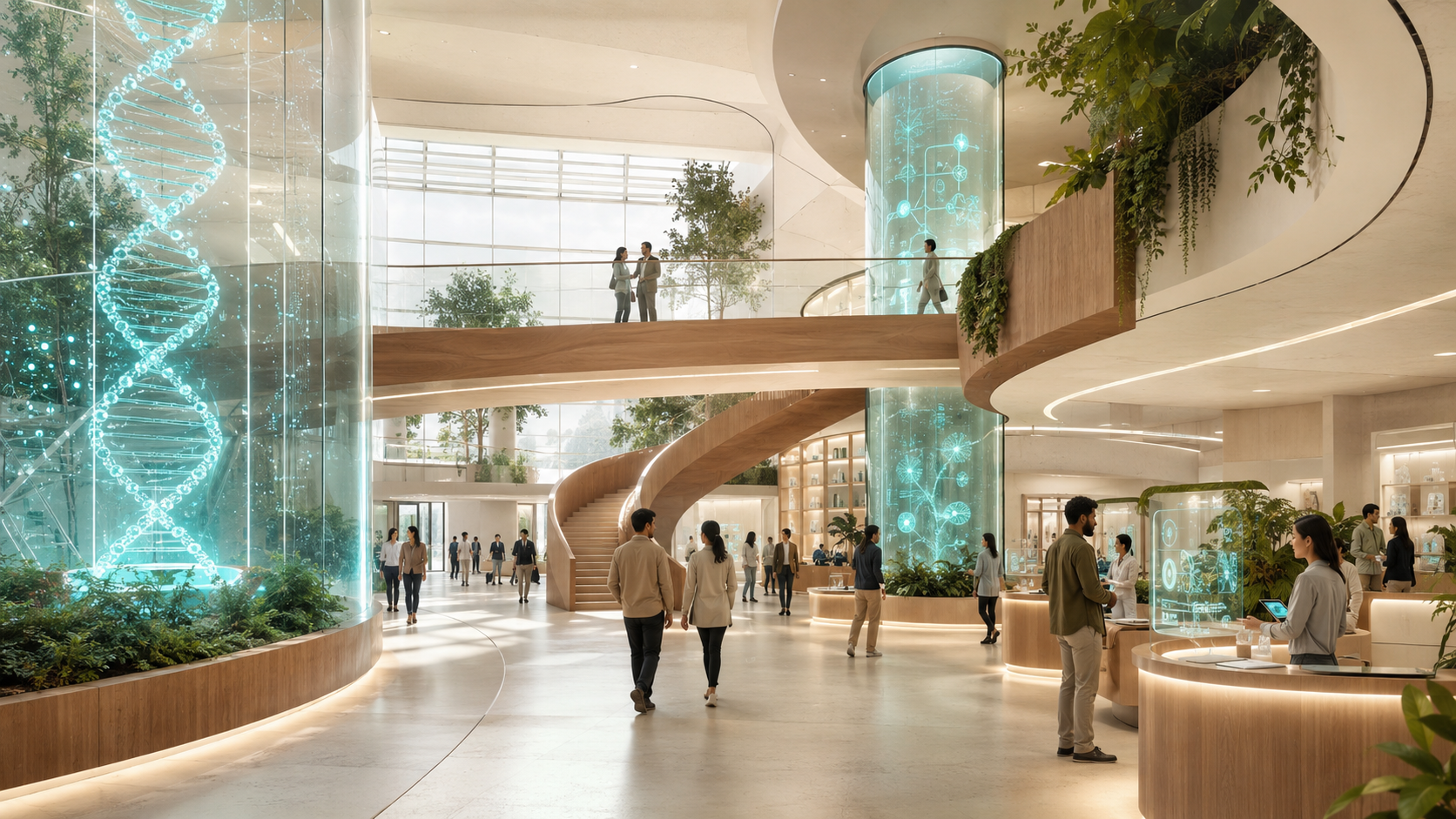
The future of genomics is already arriving through hospitals, startups, IVF clinics, cancer boards, food companies, defence programmes, AI labs, public-health systems and research institutes that most people never hear about.
Because “this could be regulated” and “this is currently regulated” are not the same claim — and the gap between them is where irreversible mistakes happen.
But what we do is actually just a fraction of what we can technically do. There are a few laws regulating for example how you can genetically modify organisms, clone organisms, or grow designer human cells or embryos. But my opinion is that the whole system is much more bounded by ethics boards, sticky tape and common decency than anything else. The system works as long as everyone plays nicely, but breaks if even a single rogue actor goes off and does something different, like He Jiankui in 2018 (see below). A small biotech company, a sect leader or a disgruntled postdoc, combined with a set of off-the-shelf chemicals, may be all it takes for a very unique and powerful synthetic biological construct to be released into nature, or a very powerful bioweapon to be created.
This part of the book looks forward, but not in the lazy “one day, perhaps” sense. The future is already visible in the tools we have now: mass sequencing, gene editing, stem cells, synthetic biology, biological data at planetary scale, and AI systems. We can search and change living systems faster than any people before us. And because biology are living things which evolve, what we are building are highly unpredictable futures. Human history is already littered with ecological disasters, a mass extinction event, invasive species and ecosystem collapses which we created. And now we’ve just handed ourselves the tools to do all of that faster and more effectively.
The question is not whether genomics will change the future. The question is who gets to shape it, who gets protected from it, who profits from it, and who is left standing outside while someone else patents the door, or changes the biosphere or genetics of all of humans forever, without holding a referendum first.
This is the part where the book stops whispering
The book follows genomics into AI, biosecurity, engineered cells, edited embryos, longer lives, new medicines, new industries, biological weapons, ecological interventions and the uncomfortable possibility that the next great technology platform may be life itself.
AI gives biology a new engine
AI changes the scale of what we can interpret. AlphaFold’s protein-structure database now provides open access to more than 200 million predicted protein structures, which is the kind of number that makes “we looked at some proteins” sound like someone searched their handbag for a receipt, and only a few years ago it could still take several years to solve the protein structure of one protein!
That does not mean AI understands biology like a benevolent God – far from it – the same inaccuracies and ambiguities which niggle you when you ask a large language model about something as simple as “What is a good breakfast?” is inherent in AI models for biology too. AI can help predict structures, find patterns, interpret variants, design molecules, analyse cells, model disease and suggest experiments – but it does it trained on current data – which we know for sure contain innaccuracies – and is very biased in the way it has been collected. It can also be wrong with great confidence, and badly coded or badly governed systems could – completely inadvertently – help create a powerful bioweapon or enzyme. People are already using large language models, neural networks and a virtual zoo of AI technologies to create digital twins, in silico experiments, and dream up their next synthetic biology experiment. Methods for verification, fact checking, independent evidence, and fact traceability is lagging far behind.
Seeing this bias, the author, Magdalena Zarowiecki created Helminthix, which is an organisation for leveraging the efficiency gains in AI drug development to address neglected tropical diseases – which affect over 1.5 billion people in the planet, yet have few working cheap and effective medicines currently. The issue is not that it is too difficult to created medicines against NTDs, it should in fact be quite easy, because they are different than us – and medicines do exist, but it is a question about power, attention and interest.
The line between cure and redesign will get thinner
That future has already started. In 2023, the FDA approved Casgevy and Lyfgenia for sickle cell disease, and Casgevy became the first FDA-approved therapy using CRISPR/Cas9 gene editing. A severe inherited disease can now be treated by editing a patient’s own blood stem cells and returning them to the body.
But the darker future is standing right next to it, wearing the same lab coat. In 2018, He Jiankui announced the birth of the first CRISPR-edited babies, an experiment widely condemned by scientists and ethicists and followed by a prison sentence in China.
That is the central tension of the genomic revolution. The same field that can treat suffering can also tempt people toward enhancement, embryo editing, private reproductive markets and “better humans” with suspiciously old-fashioned ideas about what better means. Personalised treatments, to the point of gene editing of embryos or certain cells, using a range of different methods are still complicated, sometimes dangerous, very costly, and difficult to bring to the patients, but that will change over the coming 5-10 years. We will literally be able to go into a patients genome, work out what is not working, cut/edit/replace or compensate for it, leaving the patient with a modified healthier genome. Will we stop at healthier, or will we be tempted to go further?
Biosecurity is not a movie plot
Covid should have ended the idea that biology is soft, background scenery. A virus with a genome of roughly 30,000 DNA letters disrupted schools, hospitals, borders, economies, care homes, politics, funerals and caused millions of deaths. Antimicrobial resistance was directly responsible for an estimated 1.27 million deaths in 2019 and associated with 4.95 million deaths. So even a small virus or organism nobody has ever heard of is completely capable of disrupting our entire lives – don’t forget that.
The future risk is not only natural pandemics. Add cheaper DNA synthesis, gene editing, AI design tools and badly governed laboratories, and biosecurity becomes one of the most serious questions in the book. The point is not to panic. The point is to stop treating biological risk as something that only happens in films with terrible lighting, and unbelievable plot twists. Governments and defense departments all over the world are already quietly beefing up their biosecurity departments, and preparing for a whole new set of challenges, and the threat is real and urgent. I hope that the general public gets included too, so that we all can help in defending the genomics of humanity, and the biosphere – literally the most precious thing we have, and what we all depend on!
Question Box
What genomic future would you actually permit?
Imagine the tools become cheaper, safer and more available. Would you allow gene editing to cure fatal childhood disease, prevent blindness, reduce dementia risk, increase muscle strength, change embryos, alter crops, remove invasive species, engineer microbes to eat plastic, or extend healthy life far beyond what we now consider normal?
Who should decide? Market power, companies, clinics, governments or desperate parents trying to feed their children?
Why this matters now
Other futures should frighten us. Genomics could intensify inequality, create new surveillance systems, commercialise reproduction, destabilise ecosystems, enable targeted biological harm or make the living world another platform owned by people who call extraction “innovation”.
This book is not asking readers to reject genomics. It is asking them to stop sleepwalking into it.
Continue the journey
Next, the book closes by asking what we do with all this power. Reading life, editing life and computing life are no longer separate scientific tricks; together, they form a new human relationship with the living world.
Further reading and source notes
Read the book before the future of life is made without you in the room.