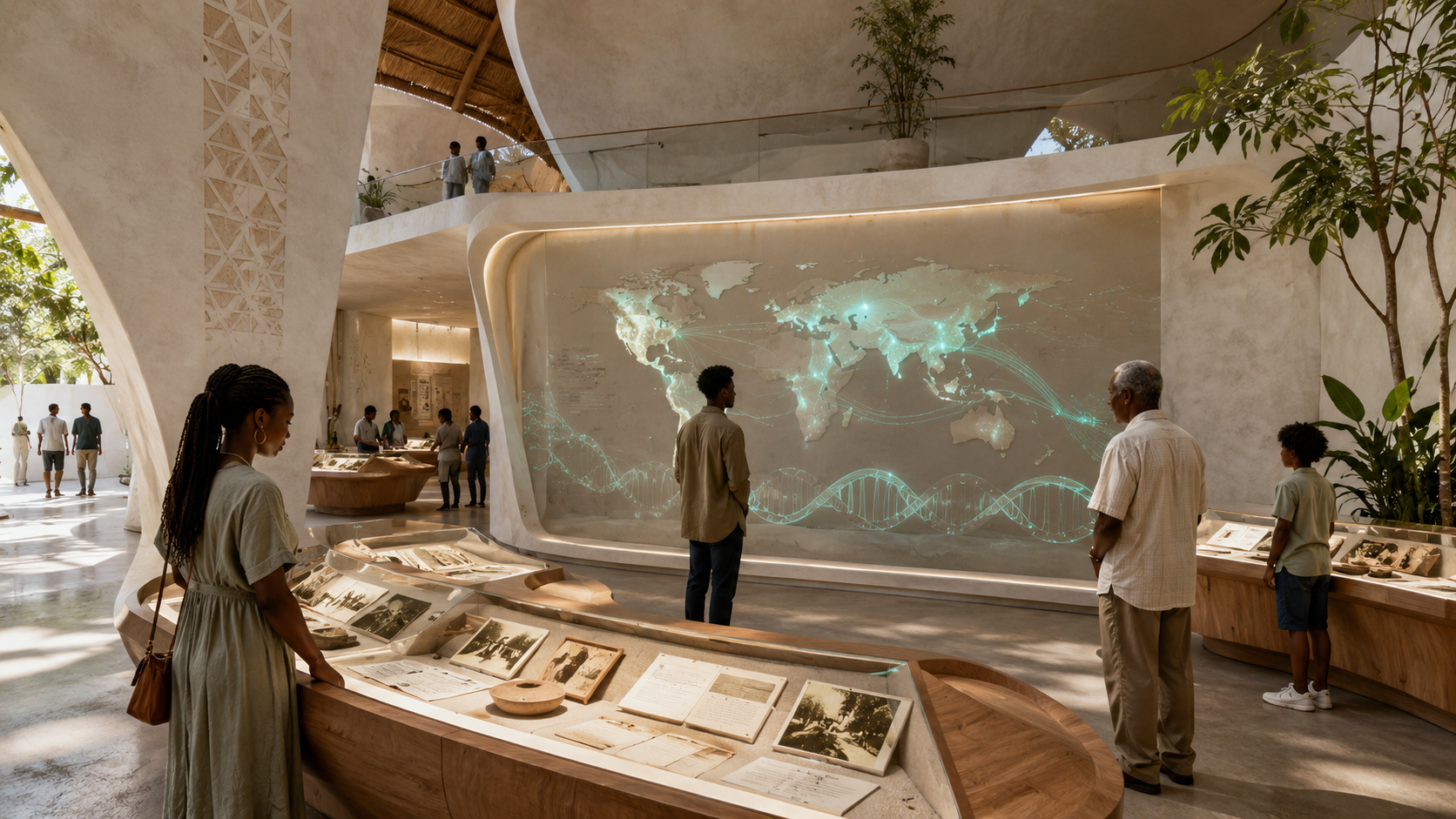
Genomic History
Part 02 · The Genomic Power Shift
DNA remembers things people forgot, buried, embellished, or got completely wrong
History used to depend mostly on bones, ruins, tools, documents, portraits, family stories, and whoever had enough power to write things down. DNA has changed that, because a small piece of bone, tooth, hair, blood or saliva can now add a new witness to the room.
That witness is not always polite. DNA does not care about royal dignity, national myths, family pride, adoption secrets, old scandals, racist fantasies, or what someone’s grandmother insisted was absolutely true because “everybody knew it”.
This part of the book is about genomics as a history machine. It can reconstruct the story of life, redraw human migration, identify the dead, connect the living, expose family secrets, and remind us that human beings are far more mixed and closely related than our social categories suggest.
Because the DNA test you or a relative take for fun can just as easily rewrite your family’s story, your ancestry claims or someone’s legal case — whether or not anyone was ready for what it finds.
The past has become sequenceable
DNA can write the history of life long before humans enter the scene. By comparing DNA between organisms, scientists can reconstruct how species are related, when populations split, how they moved, and how they adapted to new environments.
That sounds abstract until you realise what it means. DNA can help us look back hundreds of millions of years back in time, long before anyone had a backbone. We can ask whether fungi are more closely related to plants or animals, how mammals diversified, where crops came from, how pathogens travelled, and how species responded to climate change, in a more unbiased way. My own research brought me to study how climate change and sea levels in Southeast Asia had impacted the mosquito populations which today transmit malaria.
The same DNA tools now reach into human history. In 2012, a skeleton was found under a car park in Leicester, at the site of the former Grey Friars friary, and DNA analysis helped confirm that the remains were those of king Richard III, more than 500 years after his death.
In Sweden, DNA is also helping tell the story of the people who died on the warship Vasa, which sank on its maiden voyage in 1628. About 30 people died, and modern DNA analysis of the recovered skeletons has helped researchers investigate sex, appearance, ancestry and identity, including the discovery that one skeleton long assumed to be male was actually from a woman.
So yes, history can still be written by the winners. But increasingly, it can also be corrected by the bones.
We were not the only humans in town
All living humans belong to Homo sapiens, a species that evolved in Africa around 300,000 years ago. But for much of our history, we were not alone, and the neat little “ape to modern man” picture from old textbooks is far too tidy.
Other human species and close relatives shared the planet with us. Homo erectus lived for well over a million years and spread from Africa into Asia, Homo floresiensis was a small-bodied human species on the island of Flores in Indonesia, and Denisovans were identified largely through DNA from remains found in Denisova Cave in Siberia.
Then there were the Neanderthals, who lived across Eurasia for hundreds of thousands of years and were not the stupid grunting cave caricatures people still might imagine. Ancient DNA shows that many people with ancestry outside Africa carry around 1–2% Neanderthal DNA today, which is not a personality diagnosis nor does it explain your husband’s behaviour at IKEA. We moved, met, and we mixed.
This matters because genomics makes human history stranger, richer and less pure than old identity stories like to admit. We did not come from a clean family tree with tidy branches; we came from migrations, bottlenecks, extinctions, separations, reunions, interbreeding and survival.
Genomics does not support racism
One of the most important messages in this part of the book is very simple. Genomics does not support racism, xenophobia, racial purity, genetic hierarchy or the idea that one group of people is biologically “better” than another.
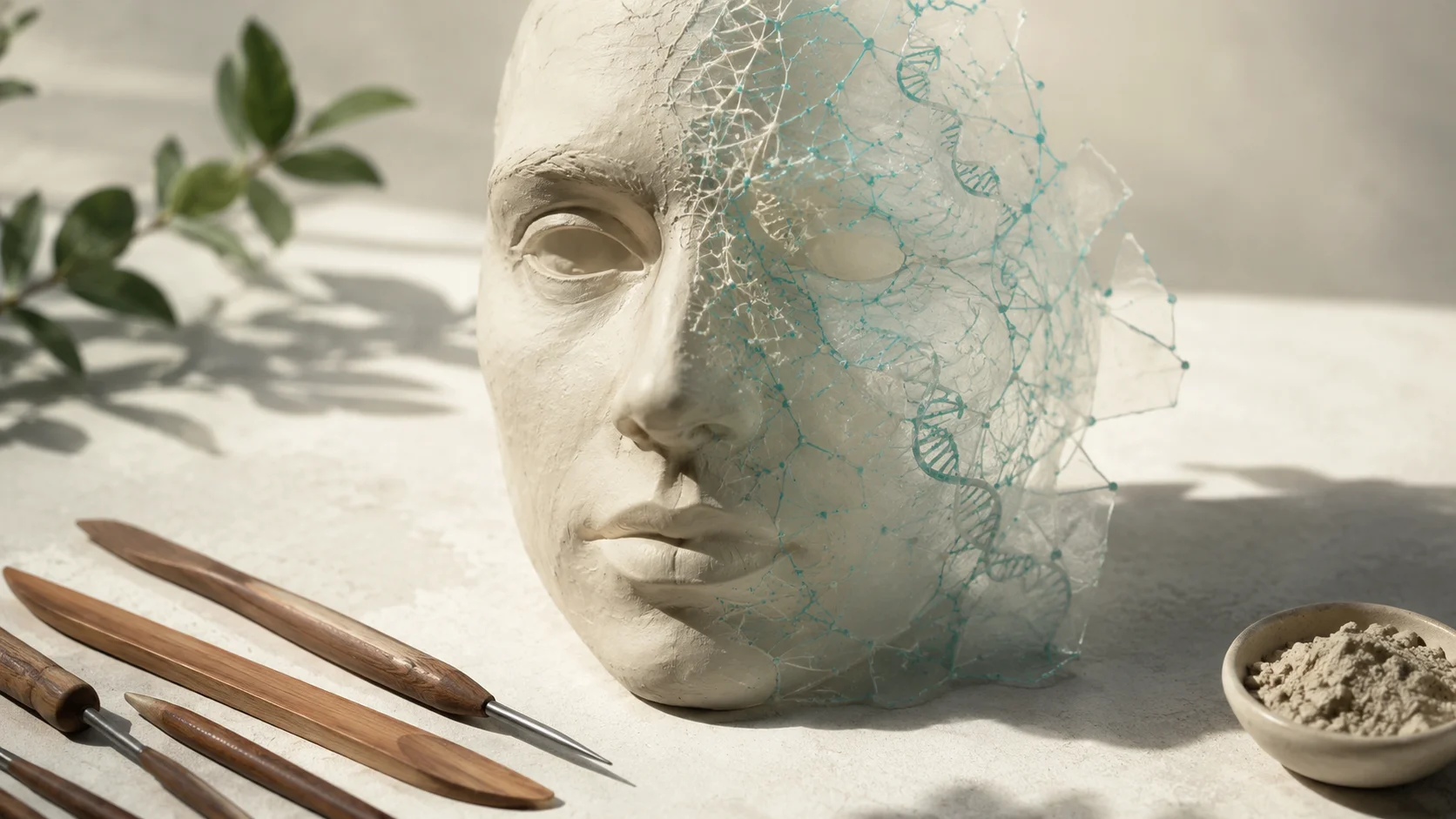
Human beings are genetically very close to one another. A classic 2002 study by Rosenberg and colleagues found that differences between individuals within the same population accounted for 93–95% of human genetic variation, while differences between major groups accounted for only 3–5%.
Of course, all humans are not genetically identical. Skin colour, hair texture, eye colour, height, lactose tolerance and many other traits vary between individuals and populations, and some of those patterns reflect ancestry, migration, diet, sunlight, climate, chance and adaptation. In my opinion, it is a reflection of that humans are a very widespread species – to be found on all continents, which is remarkable given that most other species never travel as far as we do.
But visible differences are a tiny and misleading slice of human biology. You cannot look at a person’s skin colour, eye colour, hair type, height, ancestry label or ability to roll their tongue and read their intelligence, kindness, courage, trustworthiness, creativity or worth. If you think you can, that is prejudice wearing a lab coat and hoping no one checks the references.
Previous generations of geneticists have done massive blunders in this area, which is very regrettable. They let the zeitgeist of the time they lived in, combined with poor knowledge of human DNA, lead them to some terribly wrong conclusions. Even today, there is a risk of human genetics being confused with ethnicity, cultural identity, origin, opinion and politics. It is misleading, wrong and very dangerous. Imagine if it would turn out that one of Angelina Jolie’s children had an identical twin in Ethiopia. They’d have identical DNA, but completely different culture, values and life experience. The same principles apply to all of us, without restrictions. You cannot know about a persons life experience or skills from a three second glance at them.
Your ancestry test is not just about you
Ancient DNA may rewrite museum labels, but consumer DNA testing can rewrite dinner tables. A test bought for fun can help someone find biological parents after adoption, reconnect families separated by war or migration, confirm a family tree, or discover relatives they never knew existed. A DNA test may look like a harmless Christmas present, but it is not quite a scented candle. It can arrive wrapped in festive paper and leave the family group chat needing legal, emotional and genealogical support.
That can be beautiful and healing. It can also detonate secrets people were not ready to face, including unknown half-siblings, misattributed parentage, donor conception, hidden adoption, fertility-clinic scandals, or the simple fact that someone who grew up as your cousin is not genetically related to you at all.
Research on misattributed parentage varies, but recent discussions often place it somewhere around 1–4% of births in many Western populations, depending on definition, population and method. That is not “everyone’s family is a soap opera”, but it is common enough that millions of consumer DNA tests will inevitably uncover painful surprises.
This is why your genome is personal, but not only yours. It contains information about your parents, siblings, children, cousins and relatives who never clicked “I agree” on anything, and who may still have to live with whatever your test reveals.
Story time: when cousins are not cousins
Carmen and Malia had always known each other as cousins and best friends. Their families spent Christmas together, their childhood memories overlapped, and their relationship felt obvious.
One Christmas, they gave each other DNA tests for fun. When the results came back, the database said they did not seem to be related at all, which is not the kind of festive surprise anyone puts on a gift tag.
After many conversations, the family discovered a secret that had been hidden for decades. Malia’s father had been adopted, and even he had never been told.
For Carmen and Malia, the friendship survived and even became stronger. For the older generation, the discovery was painful, disorientating and life-changing, because DNA had rewritten the meaning of the family they already had, and Malia’s father – who hadn’t even participated in buying the Christmas presents – spent years trying to come to terms with his new identity.
Question Box
Should we dig up the genetic secrets of the dead?
Imagine historians are arguing about whether a princess was really the king’s daughter, whether a famous person had children no one knew about, or whether a skeleton in a museum has living descendants?
If DNA from bones, graves or living relatives could answer the question, should we use it? The answer may change a historical theory, but it may also reveal private information the person never knew themselves and that their descendants may not want exposed.
Ancient DNA can answer extraordinary questions. The harder question is whether every answer belongs to us.
Fact Box Preview: what DNA can tell us about history
DNA can help identify human remains, especially when it is combined with archaeology, radiocarbon dating, isotope analysis, written sources and living relatives. It is powerful, but it is not magic, and the best historical identifications usually come from several types of evidence agreeing with each other.
DNA can also reveal ancestry, sex, kinship, disease risk, pigmentation traits, migration patterns and population mixture. The ethical problem is that the same data can also expose private family history, disturb living descendants, or be twisted into political myths about purity, belonging and identity.
Why this matters now
More people than ever are putting DNA into ancestry databases, biobanks, medical studies and consumer testing services. That means history is no longer something only academics reconstruct from archives and museums; it is becoming something ordinary people meet through birthday presents, family-tree websites, adoption searches, health tests, police investigations and unexpected emails from strangers.
This knowledge can reconnect families, identify the dead, correct myths, solve crimes, and show that humans are far more related than racist stories allow. It can also expose secrets, unsettle identity, be misused by nationalists, and turn family history into data owned by companies.
So the right question is not whether genetic history is good or bad. The right question is who gets to ask, who gets to know, who gets to consent, and who has to live with the answer.
Continue the journey
Next, the book moves from ancestry and history to scale. One genome is intimate, but a million genomes is infrastructure, and that is when the questions become much bigger than one family tree.
When nations, hospitals, companies and biobanks collect genomes at scale, we have to ask who owns the data, who gets access, who profits, who is protected, who is left out, and what happens when your genome becomes part of a national or commercial system.
Further reading and source notes
- Richard III identification study
- University of Leicester: Richard III DNA results
- Vasa Museum: research on the skeletons
- Uppsala University: Vasa skeleton G identified as female
- Rosenberg et al.: human genetic variation
- American Society of Human Genetics statement against genetic racial supremacy
- Smithsonian: Homo sapiens
- Smithsonian: Homo erectus
- Natural History Museum: Homo floresiensis
- National Human Genome Research Institute: Neanderthal DNA
- Research discussion of misattributed paternity
History is no longer only written in books. It is written in bone, blood, saliva, family databases and the genetic traces we leave behind.
Read the book before someone else explains your DNA to you badly.